
A Reckoning
The first letter was the roadmap. The second was the hundred-year record. This is the question underneath both — if it works like this, why do we still keep it?

This is Part III of a three-part series.
Everyone is watching the wrong number.
Wall Street called Warsh’s first meeting hawkish, and it was: a hold at 3.50–3.75, half the committee now expecting a hike, a year-end inflation mark of 3.6, the market betting on a hike by fall. The whole debate is a quarter-point either way.
I read it the other way: the cuts are still coming. The inflation that spooked the committee is mostly a one-time oil shock, and it’s already reversing as the Iran framework reopens Hormuz and Brent falls back through eighty. And the hawkish projections aren’t the chair’s — Warsh wouldn’t put his own number down, and he threw out forward guidance entirely. That’s not a Fed pre-committing to a hike. That’s a Fed keeping the room free to cut the moment the oil shock fades. As Bloomberg’s Anna Wong put it, hiking into a one-time shock that’s already reversing wouldn’t prove the Fed independent or tough — it would just prove, one more time, that it misreads inflation in real time. Here’s the real tell: the most reflexive Fed-basher in modern history — the man who threatened to fire the last chair for cutting too slowly — looked at a hawkish hold from his own appointee and shrugged: “It’s all right. Whatever.” Asked about a hike, he said he’s “guided by what he wants.” You don’t talk that way about a man you think is about to hike you into a recession.
A caveat on the oil, because it matters less than it looks. I read the drop as transitory — a war premium coming out. Someone sharper could read it as a deliberate valve: Hormuz reopening at the exact moment the administration needed a cooler print. Short term, you can’t tell those two stories apart. They draw the identical chart. So I won’t hang anything on it.
Here’s the part to sit with: cut or no cut, we end up in the same place.
Say I’m wrong about the oil and the cut. Say Warsh is a genuine hawk, the committee means every word, the rate stays high into 2027. It barely touches what actually drives this market. The rate is the price on the board. What moves price is the liquidity underneath it — and that water never stopped running.
Look at what’s actually feeding the system. Three pipes are pouring in, and not one of them runs off the policy rate. Stablecoin reserves now sit in Treasury bills — Tether alone holds more U.S. government paper than Germany does — a new buyer that grows with crypto, not with the funds rate. The fiscal hose runs wide open — deficits near six percent of GDP, the Treasury issuing into every quarter it can. And the AI build-out is its own flood — the hyperscalers alone are spending north of six hundred billion dollars this year, nearly double last year, landing in the real economy no matter what money costs. None of it asks what the rate is. The water keeps coming.
And the Fed’s own pipe never closed. Quantitative tightening was quietly halted in December. The balance sheet still sits near $6.7 trillion — more than seven times its size the day before the 2008 crisis — and nobody in the building pretends it’s going back. Call it QE or don’t. The spigot under the policy rate stayed open.
Now the strongest version of the other side. The most-watched liquidity analysts are leaning the other way. Bloomberg’s Simon White shows that excess liquidity — the surplus of real money growth over what the economy actually needs — has gone negative for the first time since 2021, the kind of reading that has bled risk assets a couple of quarters later. Albert Edwards says the squeeze is just getting started. Point taken.
Both are right — “liquidity” is two gauges wearing one word. Gross liquidity — the total pool — is at a record: Michael Howell’s global measure printed an all-time high in June and is still climbing on a three-month basis. Excess liquidity — what’s left after the real economy takes its cut — is shrinking. Both are true at once, and here’s the bridge: the build-out and the deficit are big enough to soak up the new money before it can drive another leg up. That’s not the spigot closing. It’s the spigot pouring into a bigger bucket.
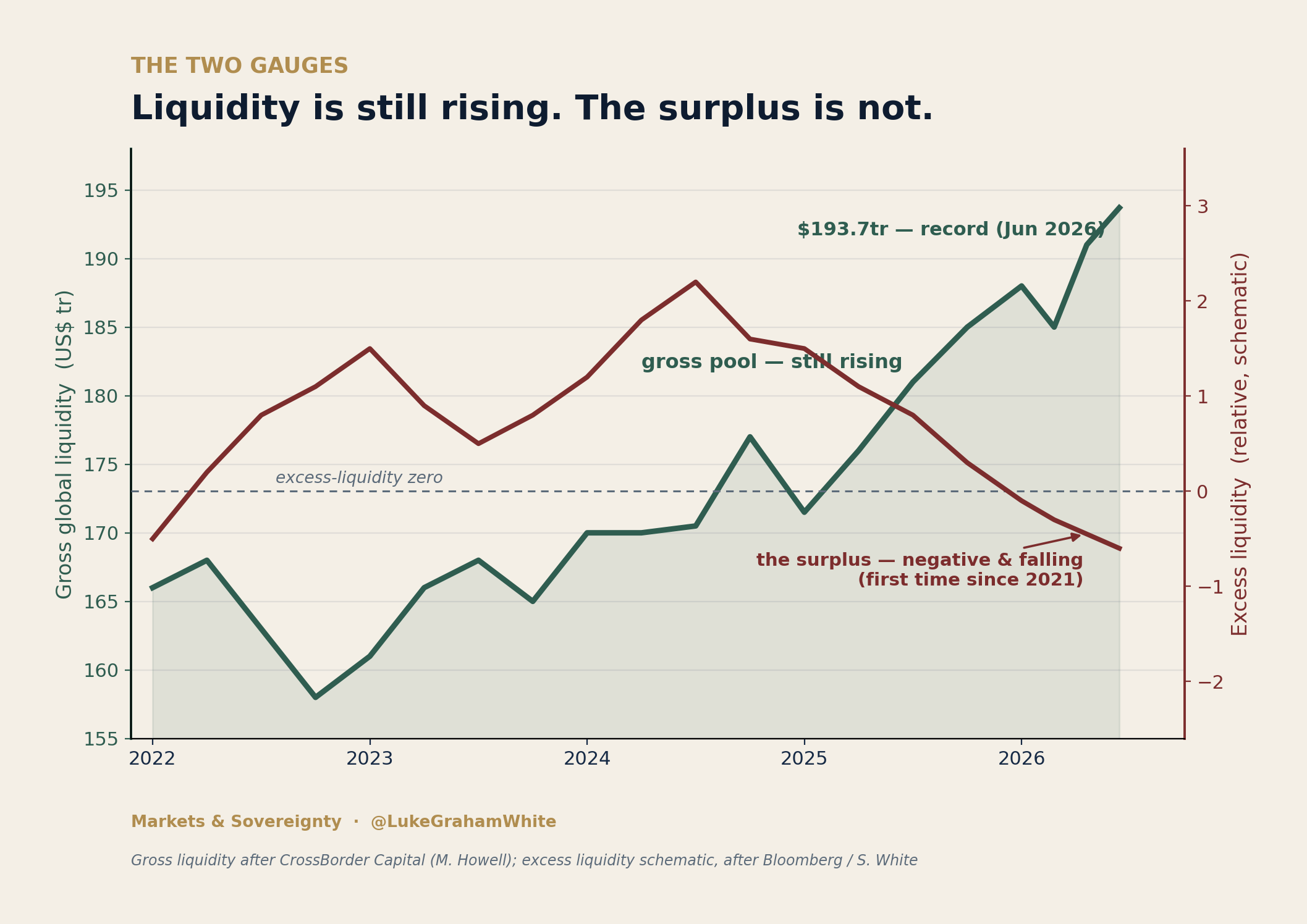
Which is what a top looks like. Maximum liquidity, maximum absorption, risk appetite rolling over while the level still reads full — what Howell calls the speculative late stage, where risk assets turn fragile even as the pool keeps filling. Their case is about the flow. Mine is about the floor. Late cycle is when both sides are right at once — and which way it breaks, the shallow shake-out or the deep one, is the fork I drew in Rotation Compresses.
So strip it to what’s actually in dispute. The machine — money created near the banks, reaching the wage-earner only after it has lost value — isn’t contested; people just describe it from different sides of the room. That there’s one more leg before this breaks is my base case, though plenty take the other side. That the bill comes due eventually, almost nobody disputes. The one clean, datable disagreement left is the cut — and the cut isn’t the binding variable.
So watch the water, not the price board — the liquidity, not the rate. A cut would confirm what is already true, not cause it; no cut, and the flow keeps running anyway. And yes, a sufficiently high rate, held long enough, does eventually bite — the Fed can drain reserves, it can break the carry trades, it can shorten duration in portfolios that cannot take it. But the rate has to be doing that work for long enough to matter. Right now, three pipes are pouring in faster than the rate can restrict them. When the spigots close — when fiscal policy flips or the build-out pauses or stablecoin demand reverts — then the rate becomes the binding variable again. Until then, it is one input among the inputs that are actually moving the money.
Which is the thread this whole series has been pulling. Because if the liquidity never stops — under every chair, hawk or dove, through every cycle — then killing forward guidance, abstaining from the dot plot, and standing up five task forces doesn’t turn the machine off. It just stops narrating it. Warsh isn’t ending the thing. He’s stepping back from the controls and letting it run quieter.
Which forces the question the rest of this letter is about. If the water never stops, what is the institution actually for — and who pays for the thing it can no longer stop doing?
FIRST, THE CASE FOR IT
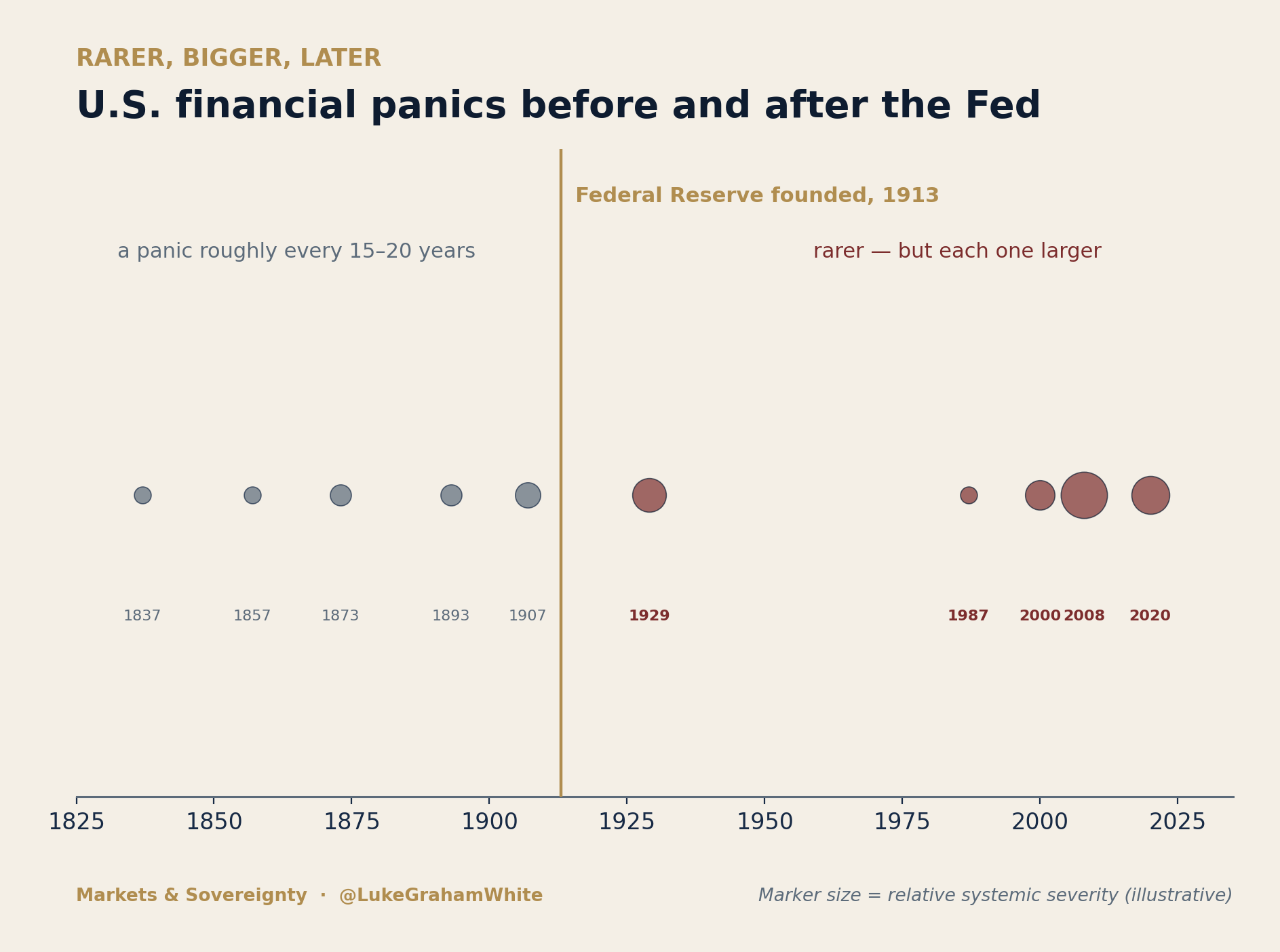
Before the Fed, the American banking system broke roughly once a decade. 1837. 1857. 1873. 1893. 1907. Not recessions — runs. Depositors lining up in the cold, sound banks and unsound banks dragged down together because nobody could tell which was which, credit vanishing exactly when the economy needed it most. In 1907 the panic got bad enough that a single private citizen, J.P. Morgan, had to lock the country’s bankers in his library and personally will a rescue into existence. Congress looked at that and drew the correct conclusion: a financial system whose last line of defense is the mood of one rich man is not a financial system. It’s a hostage situation.
So they built a lender of last resort. And when the test came — 2008, then 2020 — it worked. Bernanke had studied the Depression his whole life, and when the interbank market seized he flooded it, backstopped the money funds, swapped dollars to fourteen foreign central banks, and kept the payment system breathing. In March 2020 the Fed caught a falling knife the size of the entire economy in about three weeks. Whatever you think of what came after, the counterfactual — a 1930s-style cascade with nine thousand banks failing and a third of the money supply evaporating — was worse. Much worse.
That is the case, and it is not a small one. The Fed prevents the acute thing. The panic, the run, the cascade. It has done it twice in living memory. Take it seriously, because the people who want to tear the whole structure down rarely do.
WHAT IT ACTUALLY DOES
The Fed does not cure the instability. It launders it.
The instability is not a bug in the banking system that the Fed got hired to fix. The instability is the banking system. Fractional reserve banking — lend out far more than you hold, borrow short and lend long, promise everyone their money back on demand while it’s tied up in thirty-year mortgages — is a bank run waiting for a reason. The trick is old. The Medici were lending out their depositors’ money in fifteenth-century Florence. Two centuries later, London goldsmiths took in gold for safekeeping, issued paper receipts redeemable on demand, then realized they could lend out more receipts than they had metal — the holders never all came at once. That gap between claims and reserves is the whole machine, and it has been outrunning its own vault ever since. It generates its own panics, the way a too-tall wave generates its own collapse. The decade-clock of pre-Fed panics wasn’t bad luck. It was the system running as designed.
The Fed didn’t change that design. It backstopped it. And a backstopped unstable system doesn’t become stable — it becomes more unstable, because the backstop removes the penalty for taking the risk that makes it unstable. This is the Fed Put, and it is not a metaphor. It is a behavioral fact, born on a single day in October 1987 and compounding ever since: if the central bank will catch the fall, the rational move is to lean further out over the edge. Every rescue teaches the system to need the next one. We watched it happen across the whole back half of A Record of Regimes — LTCM feeds the dot-com leverage, the dot-com rescue inflates housing, the housing rescue inflates everything, the everything-bubble breaks into 2021, and each time the balance sheet ratchets one way: nine-tenths of a trillion to four-and-a-half after 2008, four to nine after 2020, then a retreat that stalls less than a third of the way back before the next emergency arrives.
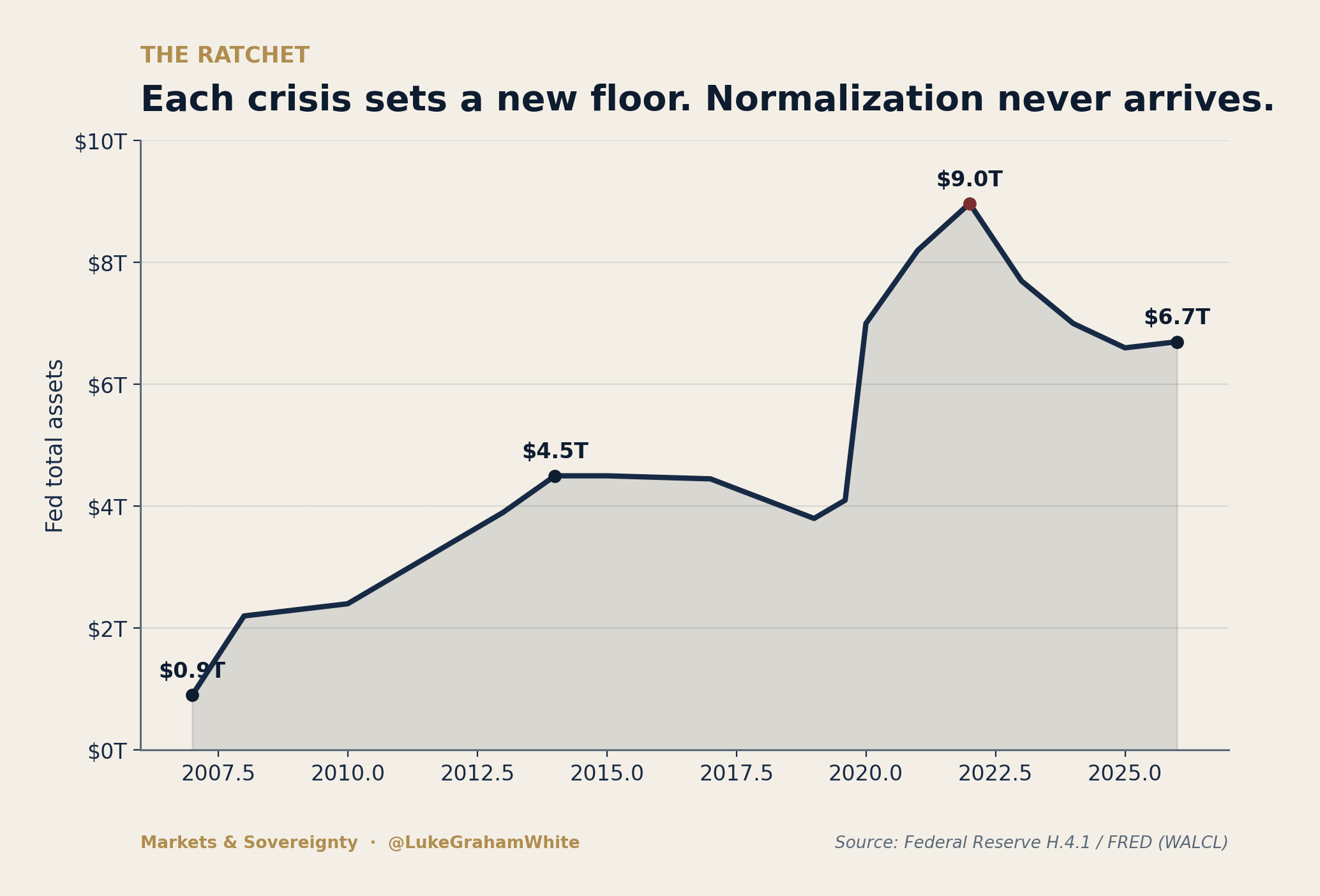
So the Fed doesn’t remove the bill. It does three things to it. It makes it (a little) rarer. It makes it bigger — each blow-off larger than the last, because the leverage builds longer. And it makes it later — pushed onto a future that gets no vote. It’s the same mistake we make with forests. A healthy forest burns small and often, and the burning is how it clears itself out. Suppress every fire and the woods look calmer for years — while the deadwood piles up. Then one fire takes everything. The Fed has spent a century stamping out every spark in the financial system. The fuel is leverage, and it never stops stacking. You can’t prove it against a control group — there’s no second America running without a Fed. But the shape is in the record: the runs got rarer, the busts got bigger. That isn’t stability. It’s borrowing calm from the present and paying it back, with interest, in a crisis you’ve made too big to fail and so too big to avoid.
And the suppression has a price that gets paid continuously, between the fires. Which is the part that should make you angry.
WHO ACTUALLY PAYS
Money is not neutral, and the people who run it know it. When the Fed creates a dollar, that dollar does not descend evenly on the whole economy like rain. It enters at a point — the banking system, the primary dealers, the asset markets — and it ripples outward from there. Whoever is closest to the point of creation spends the new money before it has moved prices. Whoever is furthest — the wage earner, the saver, the person holding cash — receives it last, after it has already bid up everything they need to buy. The eighteenth-century banker-economist Richard Cantillon described this three hundred years ago and it has never stopped being true: inflation is a transfer, and it runs uphill, from the periphery to the center, from the late to the early, from labor to capital.
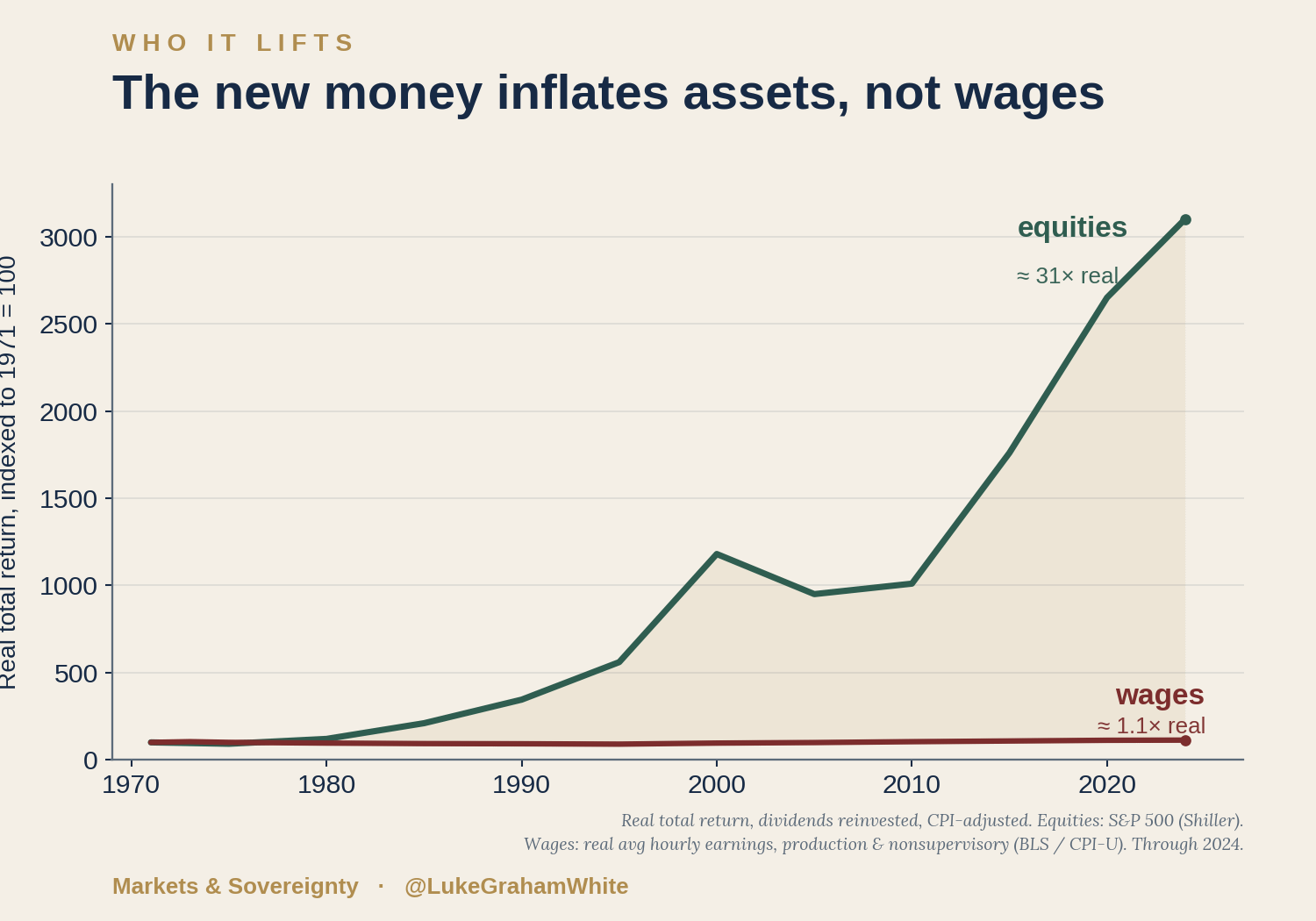
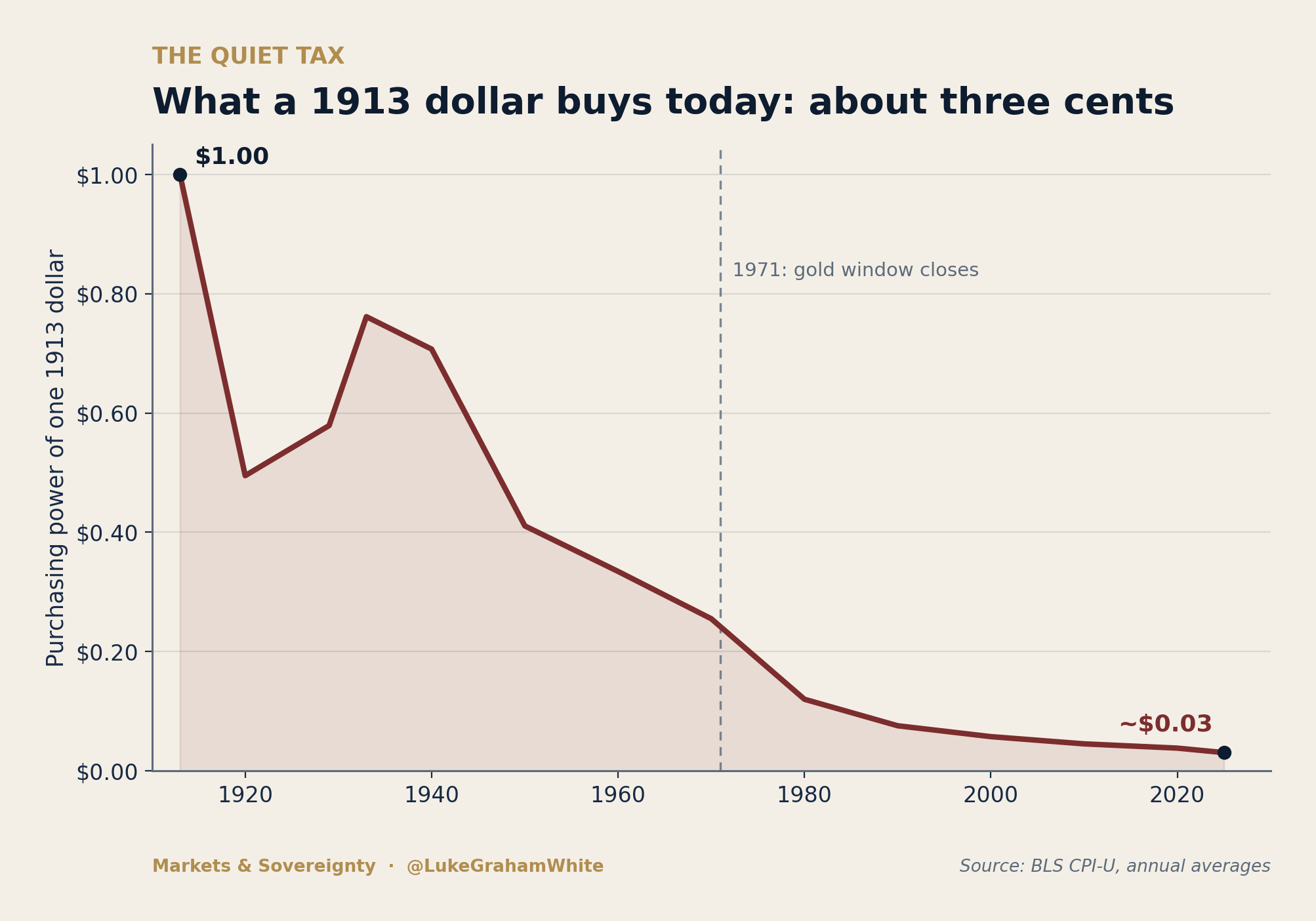
Quantitative easing didn’t soften that. It industrialized it. QE works — when it works — by lifting asset prices: make stocks and houses and bonds worth more so their owners feel rich and spend. That is the transmission mechanism, stated plainly in the Fed’s own literature, and it is regressive by construction — a wealth transfer to asset-holders dressed as stabilization. A century of it is most of the reason the gap between people who own assets and people who earn wages looks the way it does. The dollar has lost more than ninety-six percent of its purchasing power since 1913, and that loss fell hardest on exactly the people who were told the Fed was protecting them.
This is where the polite framing breaks down. The Fed is not a neutral referee above the banking system. It functions as the system’s mutual-aid society — chartered by the state, funded by an inflation tax nobody votes on, there to let the banks keep running the fractional game without being periodically destroyed by it. The Austrians — Mises, Rothbard — called that a government-sponsored cartel. The general objection: the Fed is a public institution, it answers to Congress and remits its profits to the Treasury, which no private cartel would do. True — and beside the point. An arrangement that hands its accounting profit to its sponsor while protecting its members’ franchise is still a cartel; the franchise is the prize, not the dividend. You don’t have to take the label on faith. You only have to read the founding: the blueprint for the Federal Reserve was drafted in 1910 by a handful of the country’s most powerful bankers, in secret, at a private resort on Jekyll Island, then sold to the public as a reform to discipline those same bankers. That is not a fringe reading. That is the history — an institution built by the industry it claims to oversee, to socialize its losses and privatize its gains, and performing that function with remarkable consistency for over a century.
That’s the reckoning, in one sentence: we built a machine to manage a problem the banking structure creates on its own, the machine made the problem rarer and larger and later, and it charged us for the service in a currency — our own money’s value — that it was simultaneously destroying.
WARSH’S HALF-ADMISSION
Look again at what Warsh actually did, through this frame instead of the rate-trader’s. Kill forward guidance. Stop pretending the rate path is a promise. Stand up a task force to re-examine the inflation framework, another for the data, another for the balance sheet. Shrink the footprint. The Winfree agenda underneath him — the Project 2025 Federal Reserve chapter — goes further: a single mandate, hard limits on what the Fed can buy and a wind-down of the balance sheet, rules over discretion, and, at the radical end, the two ideas that haven’t been serious in Washington since 1971 — commodity-backed money, and free banking, which is to say abolishing the Fed outright.
Read from inside the rate market, that’s a hawkish committee. Read from inside this series, it’s something stranger and more honest. It is the institution conceding the critique. You do not spend your first meeting dismantling your own forecasting apparatus and chartering five committees to audit your own tools unless some part of you has concluded the tools don’t work. Warsh is not fixing the machine. He is quietly admitting it can’t be fixed the way it’s been run, and trying to bind it before the next crisis forces another improvisation that ratchets the balance sheet again.
But — and this is the trap from The Vise and the Broken Lever — a rules-bound Fed sitting on top of a fractional banking system is still a backstop on top of an unstable structure. You can take away the discretion and the guidance and the dot plot, and you have not touched the thing that generates the panics. You’ve just promised to be more disciplined the next time the system you’re underwriting does what it’s built to do. The half-reckoning is real, and it is not enough, and Warsh almost certainly knows it. That’s why he’s stepping back. When you can’t fix the machine and you can’t unplug it, the next best move is to make sure your fingerprints aren’t on it when it breaks.
WHAT COMES AFTER
So if the model is in its endgame — and the people running it are behaving like it is — the useful question stops being what will the Fed do and becomes what do you do about it.
Not abolish anything. That’s not a plan, it’s a bumper sticker, and the transition from a credit system this large to anything else is the kind of event the whole series has been circling, not a policy you tweet. The honest answer is smaller and older and it runs straight back through The Long Forgetting: when the unit of account is being slowly debased by an institution that cannot stop, the rational individual response is to hold the things it cannot print. Hard money you actually possess. Productive assets that throw off real yield in real terms. Networks and skills you can route around the center with. The whole architecture of the dollar is downstream of a political choice to manage instability with more of the thing that causes it — and you do not have to make that choice your own.
And here is the part that should get your attention: the people closest to the money are already edging toward the exits. The quiet talk of gold as collateral, the new seriousness about hard assets on the sovereign balance sheet, the reappearance of commodity-backed money in a serious Washington policy document for the first time in fifty years — these are not nostalgia. They are the early, deniable steps of the people who run the system hedging the system. When the house starts buying insurance on its own table, you’re allowed to notice.
THE LARGER GAME
Step all the way back, because this was never really a series about the Federal Reserve.
The Fed is just the cleanest example of the machine you actually live inside — the one that asks you to measure your whole life in a unit it is steadily devaluing, to mistake the scoreboard for the game, to spend your one finite store of attention reading the central bank instead of reading reality. Warsh just told the market to stop doing exactly that: stop asking what the Fed will do, start asking what is true. It’s good advice, and it’s bigger than markets. You don’t learn the machine this deeply to trade the next meeting. You learn it so you’re not the exit liquidity for a hundred-year-old transfer you never agreed to — and so the capital you build buys the only things it was ever good for: room, time, sovereignty, the with people you love, a life the script wasn’t built to give you.
That’s the reckoning. Not the end of the Fed. The end of needing it to tell you where you stand.
The chain doesn’t break because the institution reforms. It breaks one person at a time — when enough of us stop asking the bartender to tell us when to go home, and learn to read the room ourselves.
This is analysis, not investment advice.
Markets & Sovereignty · lukegrahamwhite.substack.com · @LukeGrahamWhite
Thanks for sharing, really interesting point regard excess liquidity!